Showing posts with label Latin America. Show all posts

Saturday, April 11, 2015

"My message to people is that the Cold War is over." Obama and Castro herald 'turning point' in US-Cuba ties


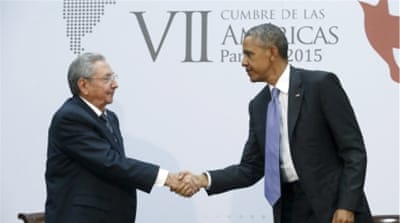
The presidents of the US and Cuba have met in Panama City, marking a potential turning point in US relations with Cuba and the region.
Barack Obama said after his meeting on Saturday with Raul Castro that the discussions had been "candid and fruitful", and that a strong majority of citizens in both Cuba and the US would back warmer relations.
"I think our ability to engage, to open up commerce and travel and people to people exchanges is ultimately going to be good for Cuban people," Obama said at the Summit of the Americas in Panama City.
"My message to people is that the Cold War is over."
Obama also said while relations would improve, that did not mean that there were not divisions between the two countries on sensitive issues such as human rights.
Castro had earlier told Obama that he was ready to discuss these issues, saying: "Everything can be on the table".
But Castro also cautioned that the two countries have "agreed to disagree" on some concerns.
"We are willing to discuss everything but we have to be patient," he said earlier
 

During a roundtable summit with other leaders of the American hemisphere earlier, Castro had praised Obama as "an honest man".
Castro said "every US president before him is to blame" for making Cuba suffer under the US blockade.
A normalisation of relations has seemed unthinkable to both Cubans and Americans for generations.
Al Jazeera's Latin America Editor Lucia Newman, reporting from Panama City, said Obama's comments did not mean that there were not divisions between the two countries.
She said Obama had not gone as far as announcing Cuba's removal from a US list of state sponsors of terrorism, as was widely expected, a move that would remove a major impediment in establishing diplomatic ties between Havana and Washington.
She quoted a seasoned political analyst with close contacts in both Washington and Havana as saying: "There must be something that the United States still wants that it is not getting, very likely related to access by US diplomats in Cuba to dissidents and other members of civil once embassies are opened,"
Our correspondent also said that Obama still had to deal with the US government embargo against Cuba and another thorny issue was Guantanamo Bay, the controversial US military prison which Cuba regarded as occupied territory.
Thawing of relations
Observers at the Summit of the Americas had still been surprised at the thawing of relations.
"Who would have guessed that of all people, President Raul Castro would sound almost conciliatory, almost like the new best friend of Barack Obama," they told Al Jazeera's Newman.
She said the meeting represented an important foreign policy achievement for Obama, who is set to end his presidency in less than two years, as well as for Castro, who is 83 and who has hinted at retiring in two years.
However, Rosa Maria Paya, a prominent Cuban dissident, told Al Jazeera that Obama had falled short in his support for "democracy advocates in Cuba".
"Obama has responded to Castro's demands, on the embargo and on wanting to take Cuba off the terrorist sponsor  list, very concrete things, but he is not so clear about the demands of the Cuban people," she said.
"His words words were symbolic, but I wanted to hear concrete demands, such as  stopping repression of opponents of the regime."

Thursday, April 9, 2015

US will remove Cuba 'terror' status


Barack Obama, the US president, has signalled he will soon remove Cuba from the US list of state sponsors of terrorism, boosting hopes for improved ties as he prepares for what's billed as an historic encounter with Raul Castro, his Cuban counterpart.
Obama's attendance at Friday's Summit of the Americas in Panama comes amid a new diplomatic outreach to Cuba, which has not attended the regional conclave since 1994.
For the first time, the US did not object to Castro attending.
Hours before his arrival in Panama, Obama said the US State Department had finished its review of Cuba's presence on the list, a major stumbling block for efforts to mend US-Cuba ties.
Ben Cardin, a US senator and top Democrat on the Senate's foreign relations panel, confirmed that the agency had recommended removing Cuba from the list, all but ensuring action by the president within days.
The highly anticipated interaction with Castro will test the power of personal diplomacy as the two leaders attempt to move past the issues that have interfered with their attempt to relaunch diplomatic relations.
The US has long since stopped accusing Cuba of supporting terrorism, and Obama has hinted at his willingness to take Cuba off the list ever since he and Castro announced a thaw in relations in December.
Yet Obama has stopped short of the formal decision amid indications that the White House was reluctant to grant Cuba's request until other issues, such as restrictions on US diplomats in Havana, were resolved.
Cuba is one of just four countries still on the US list of countries accused of repeatedly supporting global terrorism. The others are Iran, Sudan and Syria.
"Victim of US aggression"
However, Latin American policy analyst Juan Carlos Hidalgo told Al Jazeera that negoations between the US and Cuba had been held in secret "so we don't know what's going to happen".
"It's been a riling point for Cuba for over half a century, and it has been presenting itself as a victim of US aggression but now, all of a sudden the US wants to be friends with you (Cuba)," Hidalgo said.
"If you look at statements from Castro over the past months, it looks like he is trying to raise the price tag by asking the US to return Guantanamo Bay or lift the sanctions in return for closer ties."
In January, Castro said that Cuba would not improve relations with the US unless it returned the controversial naval base and military prison to Cuba and lifted the five decades-old sanctions.
Al Jazeera's diplomatic editor James Bays, reporting from Panama, said this year's summit was historic because all of the countries in the Americas were present for the first time.
"The Summit of the Americas is held every two years and in some ways this year's is a coming of age," Bays said.
"A lot of attention will be on the relationship on those two countries."
Bays said a cloud on the horizon at the summit was Obama's issuing an executive order for sanctions against Venezuelan officials a month ago.
Bays said the order could be viewed by some countries as "a clumsy move"
Source Al Jazeera

Wednesday, April 8, 2015

DEA 'Sex Scandal' is Not About Sex - It's About Corruption and Impunity in the War on Drugs

Recent revelations that DEA agents attended "sex parties" hosted by the very drug traffickers they were supposed to be fighting fell like a bombshell.
Despite the shocking headlines, though, this scandal isn't really about sex -- and it's much bigger than the DEA. At its core, this sordid tale is about the futility and corruption of prohibition -- told through the lens of a rogue agency that represents everything wrong with the war on drugs.
According to a Justice Department report, several DEA agents (some with top secret clearances) allegedly participated in multiple orgies with hired sex workers "funded by the local drug cartels." Some also received money, gifts and weapons from these traffickers. The parties occurred at the agents' "government-leased quarters", where laptops and other equipment were accessible -- raising "the possibility that DEA equipment and information also may have been compromised as a result of the agents' conduct."
This story made national news because it's the DEA. But drug traffickers dishing out favors to local, state and federal law enforcement happens every day, both inside and outside of the U.S.
Moreover, the DEA wasn't the only federal agency with personnel recently implicated in drug war-related crimes in Colombia. Though less widely reported, a much more serious allegation emerged that U.S. soldiers and military contractors sexually abused at least 54 women and girls between 2003 and 2007 while deployed as part of Plan Colombia -- the nearly $10-billion U.S. drug war military aid package.
Not one of the perpetrators has faced justice. Committed during drug war operations, these heinous acts should be treated as war crimes.
These are just the latest horrors that the U.S. drug war has unleashed on Latin America -- with the DEA often at the center. In 2012, for example, DEA agents participated in a raid in Honduras that left four innocent people murdered, including a teenager and two pregnant women.
For years the agency has been spying on governments in the region, often for political purposes not related to drugs -- prompting Venezuela, Bolivia and Ecuador to kick the DEA out of their countries. Latin American counties are increasingly rejecting drug prohibition, and each fresh episode of war crimes and human rights abuses strikes a major blow to the U.S.'s failed global drug policy.
Then there's the DEA's long history of heavy-handed and shady actions at home: its rejection of science and obstruction of research; its promotion of militarization; its no-knock raids and airline passenger searches; its use of NSA data to spy on U.S. residents and to systematically fabricate evidence; its dehumanizing detention practices; its widespread and controversial reliance on confidential informants; and its role in creating and maintaining a system of mass incarceration.
Just days after the Colombia scandal broke, news surfaced that a DEA and Secret Service agent stole or extorted hundreds of thousands of dollars in bitcoins while investigating the Silk Road online drug market.
DEA Administrator Michele Leonhart herself has been at the center of several scandals, including the House of Death scandal in which the DEA appears to have turned a blind eye to torture and murder in Ciudad Juarez, and the Andrew Chambers scandal, in which the DEA rehired a confidential informant with a history of lying.
All told, the picture that emerges is an out-of-control agency, run amok, literally in bed with organized crime, a perfect symbol for the corruption and impunity inherent in the war on drugs.
The DEA must immediately be reined in and held accountable -- a small but crucial step in ending the disastrous drug war at home and abroad.
Daniel Robelo is the research coordinator for the Drug Policy Alliance.
This post originally ran on the Drug Policy Alliance blog

Tuesday, February 19, 2013

"In this revolution the citizens are in charge, not capital,"

Ecuador's Correa breezes to 2nd re-election

 Quito, Feb 18 A landslide second re-election secured, President Rafael Correa immediately vowed to deepen the "citizen's revolution" that has lifted tens of thousands of Ecuadoreans out of poverty as he expanded the welfare
state.
"In this revolution the citizens are in charge, not capital," the leftist US-trained economist said after winning 56.9 per cent of the vote yesterday against 23.8 per cent for his closest challenger, longtime banker Guillermo Lasso.
With 57 per cent of the vote counted, former President Lucio Gutierrez finished third with 6 per cent. The remainder was divided among five other candidates. Lasso conceded defeat late yesterday.
The fiery-tongued Correa has brought surprising stability to an oil-exporting nation of 14.6 million with a history of unruliness that cycled through seven presidents in the decade before him.
With the help of oil prices that have hovered around USD 100 a barrel, he has raised lower-class living standards and widened the welfare state with region-leading social spending.
The 48-year-old Correa dedicated his victory to his cancer-stricken friend President Hugo Chavez of Venezuela, who some analysts have suggested he could succeed as the standard-bearer of Latin America's left.
"We are only here to serve you. Nothing for us.
Everything for you," Correa told cheering supporters from the balcony of the Carondelet presidential palace yesterday shortly after polls closed.
Yet Correa has also drawn wide rebuke for intolerance of dissent and some analysts have questioned how sustainable his economic policies are. The number of people working for the government has burgeoned from 16,000 to 90,000 during Correa's current term if office, Ecuador's nongovernmental Observatory of Fiscal Policy reported in December.
Michael Shifter, president of the Inter-American Dialogue think tank, called Correa's ramping up of social spending "simply applying the standard recipe for many populist governments in the region." While it succeeds in building
political support in the short term, he said, it is not clear whether it is sustainable.
And while Correa has shown himself to be the "undisputed rhetorical leader of Latin America's left" and should now see his standing enhanced there Shifter said Correa's consolidation of power have damaged Ecuador's "already precarious institutions" and he lacks the clout, the ambition
and the coffers to build a coalition that could curtail US power in the region.
AP

Monday, February 18, 2013

The growing Venezuela is a achievement of Hugo Chavez

Reading the international press, one would be forgiven for thinking that Venezuela is on the verge of collapse.
Over the past decade, all sorts of predictions have been made, ranging from catastrophic election defeats to the implosion of the Venezuelan economy. But the fact these predictions have failed to materialize has not deterred many of Venezuela's most fervent critics in their quest to engineer a constant and misleading narrative of impending disaster.
The reality is that ever since President Hugo Chavez was first elected, Venezuela has defied these negative predictions and brought unprecedented social progress to the country over the last 14 years. Since 2004 poverty has been reduced by half and extreme poverty has been cut by 70%. University enrolment has doubled, entitlement to public pensions has tripled, and access to health care and all levels of education have been dramatically expanded.
Venezuela now has the lowest levels of economic inequality of any Latin American country as measured by the Gini coefficient. Our country has already achieved many of the Millennium Development Goals, and is well on target to achieve all eight by the 2015 deadline.
This progress has been achieved by using Venezuela's vast oil revenues to transform the lives of ordinary people. The sheer scale of our oil reserves -- the world's largest -- guarantees the complete sustainability of the model in which the country's resources are used to stimulate growth in the economy and aid development.

But Chavez's most significant achievement has been to trigger the awakening and empowerment of the majority. A majority of Venezuelans have seen vast improvements in their living standards and, as a consequence, they have continued to defend their interests at the ballot box.
The Venezuelan people are very clear about what they want. President Chavez was re-elected in October 2012 with 54% of the vote in an election that boasted an 81% turnout. The Venezuelan people showed their support for the government again in December 2012 in the gubernatorial elections, which saw Chavez's political party win 20 out of 23 states.
Governments in Europe and other parts of the world could only dream of these levels of support after 14 years in power. This shows that social progress in Venezuela has been consolidated and that there is a desire to further expand this progress.
In the coming years, the Venezuelan government will continue to respond to the needs of the Venezuelan people. Hundreds of thousands of new homes have been built over the last two years which have not only greatly improved living standards but also provided jobs and contributed to a boom in the construction industry. The government is well on its way to meeting its target of building three million new homes by 2019.
While many economies around the world are shrinking, the Venezuelan economy grew by 5.5% in 2012. Against the backdrop of a continuing international financial crisis, commerce in Venezuela grew by 9.2% and communications by 7.2%, manufacturing grew by 2.1% and the oil sector grew by 1.4% -- making Venezuela one of the fastest growing economies in Latin America.
At a time when many countries are attacking the rights of the most vulnerable sectors of society, Venezuela is providing ever greater protection for low-income senior citizens and single-parent families with younger children or disabled dependents.
The failed development models of previous governments condemned millions of Venezuelans to poverty. Before the election of Chavez in 1998, Venezuela suffered years of falling GDP. The country had one of the worst economic records in the world -- a record that led to mass social unrest and violent military crackdowns.
Venezuela will continue on its path of social progress and empowering ordinary citizens. The greatest hope for the future is the people know that they alone hold the power to determine the direction the country will take.
After so many failed predictions, isn't it time to respect Venezuela's democracy and the will of the people?

Saturday, January 5, 2013

Opposition call for new polls rejected by Venezuela VP

Venezuela’s Vice-President said on Friday that President Hugo Chavez could be sworn in by the Supreme Court later on if he’s not able to take the oath of office next week before legislators because of his struggle with cancer.
Vice-President Nicolas Maduro made the comment in a televised interview on Friday night, dismissing the argument by some opposition leaders that new elections must be called if Mr. Chavez doesn’t take office as scheduled on Thursday. His stance appeared likely to generate friction between the government and opposition over the legality of putting off the swearing-in, which the Constitution says should occur on Thursday before the National Assembly.
Mr. Maduro says Mr. Chavez, as a re-elected President, remains in office beyond the inauguration date stipulated in the Constitution, and could be sworn in if necessary before the Supreme Court at a date to be determined.

Thursday, November 8, 2012

Colombian hope for stability

A breakthrough in the recently launched talks between the Colombian government and FARC rebels raises hopes of an orderly transition to stability
The recently launched peace talks in Oslo between the Fuerzas Armadas Revolucionarias de Colombia (FARC) and the Colombian government are the fourth such attempt in 30 years. Will they bear fruit this time around? If so, why?
Much is at stake. This is the longest standing armed conflict in the Western Hemisphere. The FARC were founded in 1966 as part of the wave of guerrilla movements that spawned in the wake of the Cuban Revolution. Though many of their counterparts in the rest of Latin America were defeated, some were not. The Sandinistas brought down the Somoza dictatorship in Nicaragua, and one of their leaders, Daniel Ortega, is now President. The Frente Farabundo Marti de Liberacion Nacional (FMLN) in El Salvador, after quitting the armed struggle and morphing into a political party, elected their candidate, Mauricio Funes, to the presidency in 2009. Elsewhere, former urban guerrilla leaders who spearheaded the fight against military rule in the Southern Cone (and spent time in prison for it), like Presidents Jose (“Pepe”) Mujica in Uruguay and Dilma Roussef in Brazil, serve now as elected heads of state.
Yet, a military defeat of the Colombian state by FARC, or the Ejercito de Liberacion Nacional (ELN), the other guerrilla group active in Colombia (and one not taking part in these talks), was never on the cards. With a population of 45 million and a land mass of over one million square kilometres, Colombia is much too big a country to fall prey to a band of armed insurgents that has never been larger than some 20,000 to 30,000 men and women (though, amazingly, they managed to control as much as a third of the national territory at one point in time). The question, rather, is how they have managed to survive for so long.

Geographical factors

One reason is the fragmented and rough nature of the extensive and extreme Colombian geography, marked by the high Andes mountains (the second highest in the world, after the Himalayas) and enormous rivers like the Magdalena. Vast swathes of land, some of seemingly impenetrable jungle, have never been under the effective authority of the Colombian state. This leaves ample space for insurgent groups to ply their trade, in provinces like Putumayo, Narino and Caqueta in the South, but also in the rest of rural Colombia. On the other hand, the drug trade has allowed FARC to access ample financial resources (hence the term “narco-guerrillas”). This is supplemented by kidnappings, extortions and other such unsavoury activities, though the latter have been drastically reduced under relentless assault by the Colombian military. Reported kidnappings have dwindled from 3,572 in 2000 to 305 in 2011. The murder rate is at a low of 32 per 100,000 (in Honduras, it is at 82 per 100,000 and in El Salvador it is at 66 per 100,000; the average worldwide rate is 8 per 100,000). Still, according to some estimates, the FARC, described by BBC as “the world’s richest rebel movement”, have already stashed away so much money that they could go on for a long time, making do just with the interest on it.
If so, why this renewed attempt at making peace?
As a recent report of the International Crisis Group (“Colombia: Peace at Last?”) concludes, a stalemate obtains. Thanks to the considerable build-up of the Colombian military (whose numbers have gone up from 132,000 in 2002 to 283,000 in 2010, with the police reaching 132,000) and the U.S.-supported Plan Colombia, which has provided about 7 billion dollars in military hardware and training programmes over the past decade, and their sweeping, nationwide actions, the FARC are on the defensive. Many of their leaders, from Manuel (“Tiro Fijo”) Marulanda, to Raul Reyes, el “Mono Jojoy” and Alfonso Cano, have fallen in the battlefield. Vast numbers of guerrillas have been killed, captured or otherwise demobilised. No more than 8,000 to 9000 FARC members are estimated to be in the field, down from 16,000 in 2001.
For President Juan Manuel Santos, bringing peace would be quite a feather in his cap. A former Defence Minister during the presidency of Alvaro Uribe (2002-2010), in his short two years in office, he has shown his mettle (and made the cover of TIME Magazine). Aware that more inclusive social policies are needed to redress Colombia’s abysmal inequality, he has moved in that direction on a variety of fronts. This includes legislation to provide compensation to over 4 million victims of violence. With a 0.55 Gini coefficient, Colombia has one of the most unequal income distributions in the world’s most unequal region (in India, the Gini, as measured in 2004, is 0.36 —probably higher today — in Norway, the least unequal society, 0.25 ). Colombia’s current economic boom, driven by massive foreign investment in mining and oil exploration projects in lands long considered off-limits because of the armed conflict, would acquire an additional impetus from a successful peace process. In fact, the Colombian economy is doing so well that the country is being considered for OECD membership (the “rich countries’ club”).

A detractor

Although 74 per cent of Colombians support the peace process, former President Uribe does not. After falling out with Mr. Santos, he spends much of his time attacking him, often on Twitter, of which he is an avid user ( Twitter has taken off among Colombian politicians; another avid user is Gustavo Petro, the mayor of Bogota, and a former guerrilla himself, sometimes accused of spending more time tweeting than on running the capital city). Mr. Uribe, whose government was blamed for harbouring the paramilitary squads that have taken justice into their own hands in Colombia, leading to many human rights violations, does not consider FARC a legitimate interlocutor but a criminal organisation. He believes peace negotiations only give them time to regroup and get ready to fight another day.
Yet, as opposed to what happened in the past, this time there is no ceasefire on either side. In the early 2000s, under President Andres Pastrana, FARC secured a large sanctuary in Southern Colombia as part of the conditions for a previous peace negotiation. They used it for enhanced training and smuggling operations. On this occasion, the relentless military offensive of the government continues, and the FARC understand that these are the new rules of the game.
What role does the international community play in all this?
Although the negotiating parties are all Colombians, foreign countries are very much involved. Norway, an impartial and honest power-broker with no axe to grind in a far-away country, is hosting the first phase of these talks, and is one of its guarantors. Another is Venezuela, where the government of President Hugo Chavez has had an off-and-on relationship with FARC. A third is Cuba, where the talks will move to for the second phase. Havana is the only Latin American capital where FARC leaders feel safe, and the Castro brothers have been advising them for a long time to give up the armed struggle. Chile, as chair of the Community of Latin American and Caribbean States (CELAC), and whose President, Sebastian Pinera, is a friend of Mr. Santos, is also part of the process.

Santos’ statecraft

It is a measure of Mr. Santos’ statecraft that he has not only repaired the frayed state of Colombia’s relations with Venezuela — left to him in a shambles after years of bickering over many issues, from border disputes to how to deal with FARC — but also with Cuba. In fact, Mr. Santos owes Cuba big time. The Sixth Summit of the Americas, held last April in the Colombian port city of Cartagena, almost blew up in the host country’s face. A number of countries questioned the absence of Cuba at the summit, and threatened to boycott the meeting. It was only after a visit by Mr. Santos to Havana and a hurried back-and-forth with Fidel and Raul Castro, that the Cuban government expressed it had no objection to not being invited to Cartagena, thus saving the meeting.
The conditions for a breakthrough in these peace negotiations are there. The ambitious agenda includes integrated agrarian development, political participation; termination of the conflict; solution to the problem of illegal drugs and preparation for lasting peace. The current Colombian government has the standing to offer credible guarantees to the FARC leadership. It must be kept in mind that in the 1980s, when another generation of guerrilla leaders, the M-19, gave up their weapons to form a political party, the Union Patriotica, and ran for office, several thousands of them, including their presidential candidate, and many elected Congressmen, were shot and killed by paramilitaries. In turn, despite the high turnover in their top leadership, FARC retain a significant degree of control of their membership and operations, making them a partner the government can do business with. An orderly transition to peace would be in everybody’s best interests, especially the Colombian population, exhausted after half a century of “la violencia”.
(Jorge Heine is CIGI Professor of Global Governance at the Balsillie School of International Affairs, Wilfrid Laurier University, and a Distinguished Fellow at the Centre for International Governance Innovation, in Waterloo, Ontario. His Oxford Handbook of Modern Diplomacy, co-edited with A. Cooper and R. Thakur, is forthcoming in 2013 from Oxford University Press.)

Sunday, August 5, 2012

Colombian trade unions and Free Trade Agreement

Washington - Two months after a free-trade agreement between the United States and Colombia went into effect, workers and activists are warning that US-stipulated labour reforms have not been fully implemented and have yet to result in promised improvements in the lives of workers.
"We ask President (Barack) Obama to push for more guarantees for Colombian workers," Miguel Conde, with Sintrainagro, a union representing workers on palm-oil plantations, said here on Tuesday. "In Colombia, it is easier to form an armed group than a trade union… because we still have no guarantees from the government."

Friday, July 27, 2012

Cuba's free healthcare


In 1995, Nelson Mandela declared with regard to Cuban international solidarity missions to Africa over past decades:
"Cubans came to our region as doctors, teachers, soldiers, agricultural experts, but never as colonisers. They have shared the same trenches with us in the struggle against colonialism, underdevelopment and apartheid."
The US, of course, had offered a less favourable characterisation of Cuban activities on the African continent, and accused the island nation of exporting revolution. Evidence of diabolical Cuban meddling in the internal affairs of sovereign nations included its substantial assistance in defending newly independent Angola against a US-backed South African invasion that - according to Noam Chomsky - ultimately killed a million and a half people in Angola and Mozambique.
As for more subtly packaged revolutionary exports, the New York Times reported in 2009 that, "[i]n the 50 years since the revolution, Cuba has sent more than 185,000 health professionals on medical missions to at least 103 countries".

Thursday, July 26, 2012

59th anniversary of revolution of CUBA

HAVANA (AP) — Cuba marked the 59th anniversary Thursday of the failed uprising against the Moncada military barracks that the island considers the beginning of Fidel Castro's revolution.
The main celebration kicked off at sunrise at a plaza in the eastern province of Guantanamo, home to the U.S. naval base of the same name.
The American presence in Guantanamo is a sore point for Cuba, which demands the base be shut down and accuses the U.S. of torturing terror suspects held in the military prison.

Wednesday, July 25, 2012

Venezuela is withdrawing from the Inter-American Court of Human Rights


Venezuelan President Hugo Chavez said on Tuesday the South American nation is withdrawing from a regional human rights court that Latin America's leftist leaders have increasingly criticized as a pawn of Washington.
Allies of Venezuela including Bolivia, Ecuador and Nicaragua have accused the Inter-American Court of Human Rights of improperly weighing in on disputes still being heard in domestic courts and working to undermine leftist governments.
"Venezuela is withdrawing from the Inter-American Court of Human Rights, out of dignity, and we accuse them before the world of being unfit to call themselves a human rights group," Chavez said during a military ceremony.

Tuesday, July 17, 2012

A Poll say that Chavez has big lead over rival in Venezuela

  Caracas, July 17 : President Hugo Chavez has a more than 15-point lead on his main rival ahead of Venezuela's October presidential vote, according to the latest survey from pollster Datanalisis.
    Leftist-populist Chavez, 57, who has been in power since 1999, would get 46.1 percent of votes, according to a poll conducted from June 14-23, with a sample of 1,300 voters. His opponent, Henrique Capriles, a center-leftist, would get 30.8 percent, the survey, which was released yesterday found.

Monday, July 9, 2012

Chavez accused Rival of trying to destabilise Venezuela

President Hugo Chavez and his allies accused opposition presidential candidate Henrique Capriles on Sunday of trying to provoke violence by campaigning in areas that have been bastions of support for the incumbent leader.
Mr. Chavez accused Mr. Capriles of trying to spur violence as part of a broader plan aimed at creating widespread political upheaval ahead of Venezuela’s looming Oct. 7 presidential election.
“They are going to try to destabilise the country. I’ve been saying it and everybody should be alert,” said Mr. Chavez, speaking to soldiers during a ceremony to promote military officers.

Friday, June 22, 2012

Paraguay President Fernando Lugo impeached by congress---This is a Coup.

Paraguay's Senate has voted to impeach left-wing President Fernando Lugo, forcing him to step down.
Both houses of Congress had voted on Thursday to begin impeachment proceedings over his handling of clashes between farmers and police last week in which at least 17 people died.
Mr Lugo likened the move to a coup by the right wing-controlled parliament, but said he would accept the decision.
Vice-President Federico Franco has already been sworn in as president.
He will serve the remainder of Mr Lugo's five-year term, which ends in August 2013.
After previously trying to get the Supreme Court to stop the impeachment vote, the fallen president said he accepted "what the law has stated, even though the law was twisted".
'No coup' Calling on his supporters to remain calm, he added that "the history of Paraguay and its democracy have been deeply wounded".
Mr Lugo's 2008 election ended 61 years of rule by the right-wing Colorado party.
The two main political parties, Colorado and Liberal, had put aside their differences and voted in favour of the motion to begin the impeachment trial.
The Liberals are part of Mr Lugo's ruling coalition.
In an appeal filed with Paraguay's Supreme Court on Friday, Mr Lugo's lawyers had said the proceedings do not ensure due process and that the president should have been granted more time to prepare.
A centre-right legislator, Carlos Maria, denied allegations of unconstitutionality. "There's nothing illegal here, there's no constitutional rupture, no coup," he told AP.
The impeachment sparked clashes between police on horseback and supporters of Mr Lugo massed outside the National Congress building in the capital Asuncion.
"We do not want the return of dictatorship," one protester who had travelled to the capital from the Brazilian border told the AFP news agency.
Water cannon was used by police to drive the protesters back.
'Poor performance'
The impeachment sparked clashes between police on horeseback and supporters of Mr Lugo
The impeachment motion accused Mr Lugo of a "poor performance" during the forced land eviction last Friday, in which seven police officers and at least nine farmers were killed.
Speaking on national television on Thursday, Mr Lugo said he would not resign, but "face the consequences" of the trial. He accused his opponents of carrying out an "express coup d'etat".
The Union of South American Nations has send an urgent mission of foreign ministers to Paraguay to "ensure the right to defend democracy".
Ecuador's President Rafael Correa warned that the regional bloc could invoke its "democracy clause" to sever ties with Paraguay and even close its borders if Mr Lugo is not tried according to "due process".
BBC regional analyst Leonardo Rocha says South American countries are worried that Mr Lugo, Paraguay's first left-wing president, is the victim of a political trial by the Colorado party and other right-wing groups.
Several South American countries, including neighbouring Argentina and Bolivia, have already said they do not recognise the new government, reports say.
Congressional President Jorge Oviedo Matto, left, places the presidential sash on Paraguay"s former Vice President Federico Franco Vice-President Federico Franco was sworn in as president shortly after Mr Lugo's impeachment
Land clashes During the clashes in eastern Canindeyu province that prompted the impeachment move, more than 300 police officers tried to evict 150 landless farmers from an estate owned by a wealthy businessman who is also a political opponent of Mr Lugo.
The eviction escalated into violence and the farmers opened fire on the police.
The farmers have argued the land was illegally taken during the 1954-1989 military rule of Gen Alfredo Stroessner and distributed among his allies.
Land disputes are not unusual in Paraguay, where a small fraction of the population owns about 80% of the land.
Mr Lugo - a former Catholic bishop who abandoned priesthood to enter politics - campaigned for the needs of the poor.
Before being elected in 2008, he promised land for some 87,000 landless families.
On Wednesday, in an attempt to calm tensions over the incident, Mr Lugo said he would open an investigation into what happened.
Based on BBC news

Friday, June 15, 2012

Colombian Congress approves landmark peace talks laW


The Colombian Congress has approved a law setting up guidelines for peace talks between the government and left-wing guerrilla groups.
The so-called Legal Framework for Peace calls for soft sentences for rebels if they confess and compensate victims, and agree to lay down arms.
The move marks a shift from the policies of previous governments, which have refused to negotiate with rebels.
But critics say the legislation is too lenient.
Human rights groups as well as right-wing politicians - many close to former President Alvaro Uribe - say it would allow crimes to go unpunished.
'Negotiated end'
The law, which has the backing of President Juan Manuel Santos, passed in the congress by 65 votes to three.
It applies to the Revolutionary Armed Forces of Colombia (Farc) and National Liberation Army (ELN), but does not include criminals involved with drug cartels or former paramilitary groups.

Start Quote

This is the price to pay for peace, we have to be upfront with people about it”
Hernan AndradeSenator
The Revolutionary Armed Forces of Colombia (Farc) has been weakened in recent years, but has stepped up attacks in recent months.
Lawmakers who voted in favour of the legislation say it was borne out of necessity.
"This is the price to pay for peace, we have to be upfront with people about it," Senator Hernan Andrade, a member of the governing "U" party, told Reuters news agency.
Correspondents say rebel leaders have given mixed signs that they are interested in talks, and it is not clear whether they will accept the conditions set out in the proposal.
But it is the most powerful sign that the current political class is willing to accept a negotiated end to the conflict, says the BBC's Arturo Wallace in Bogota.
That was unthinkable two years ago, he says, but the situation changed after Mr Santos came to power.
However, Mr Santos insists he will only act when he is sure the rebels mean business, our correspondent says.
BBC

Wednesday, April 11, 2012

Chavez back in Venezuela, says he's beating cancer - AP


Venezuelan President Hugo Chavez has returned to Venezuela and says he’s “doing well” following cancer treatment in Cuba.

Mr. Chavez flew to Cuba last week for his third round of radiation therapy. He began the treatments in late March after having a tumour removed. He plans to have a total of five rounds in hopes of preventing a recurrence of his illness.

The Venezuelan leader has regularly travelled to and from Cuba for cancer treatment since last June. That’s when he says an initial surgery removed his first tumour, which was the size of a baseball.

Mr. Chavez has not identified the type of cancer or the precise location where the two tumours were located.

Monday, September 12, 2011

Castro says rumors of his death make him laugh


CARACAS, Sep 10: Fidel Castro, in an audio aired on
Venezuelan state television late yesterday, joked about rumors
circulating in the capital, Miami and on Twitter over the past few
weeks that he was gravely ill or had died.
The 85-year-old former Cuban president and revolutionary
icon had been out of sight for two months until photographs
published on Thursday and yesterday showed him chatting with
Venezuelan state TV commentator Mario Silva.
Some of the shots, showing Castro having a bowl of soup and
talking with Silva, were shown on Silva's regular late-night
talk show while an audio of the interview was broadcast.
''They've killed me off any number of times,'' Castro joked
in a hoarse but steady voice when asked by Silva about the
rumors of his demise. ''The guys who make these predictions make
me laugh, as if for me death would be bad news.''
Silva said the interview took place on Tuesday in Havana,
where he had gone to put to rest false reports about Castro's
health. His program supports Venezuelan leader Hugo Chavez.
The snapshots aired on the program show a gray-haired
Castro in a white windbreaker and a gray and white plaid shirt,
gesticulating during the interview.
Shots from the meeting with Silva were first posted on a
Cuban government website on Thursday. They provided the first
glimpse of Castro since he had appeared in early July in videos
with his friend and ideological soulmate Chavez, when the
latter received treatment for cancer in Cuba.
Reuters

Friday, September 9, 2011

Latin American bloc warns against NATO action in Syria


Latin America’s leftist ALBA bloc of nations on Friday called NATO’s actions in Libya a “dangerous precedent” and warned against a similar campaign in Syria, where protesters pleaded for international protection.

Venezuelan leader Hugo Chavez, a prominent voice in the bloc, often warns of possible US aggression against his oil-rich country. He has pointed to the months-long NATO campaign in Libya as an example of “imperialist” aggression.

After meeting in Caracas, ALBA foreign ministers issued a statement saying the bloc “expresses its most urgent alarm over the threat that this same process could be repeated against Syria, taking advantage of the country's political problems.”

Taking its inspiration from South American independence hero Simon Bolivar, the bloc’s full name is the “Bolivarian Alliance for the Peoples of Our America.”

It was born in 2004 as an initiative of Chavez and Cuba's Fidel Castro, both critics of US “hegemonic” influence.

Pro-democracy protesters in Syria meanwhile on Friday called for international protection after six months of bloody rebellion.

Syria’s government has responded to the protests, inspired by Arab popular uprisings that have toppled three autocratic leaders in North Africa this year, with military assaults in which the United Nations says 2,200 people have died.

In Libya, fighters launched assaults on the final bastions of Muammar Gaddafi loyalists on Friday, with battles reported inside the holdout town of Bani Walid and near the ousted ruler's home town of Sirte.

Though Venezuela and Cuba are the loudest voices in ALBA, the group also comprises Bolivia, Nicaragua, Ecuador and the Caribbean islands of Antigua and Barbuda, Dominica, and St. Vincente and the Grenadines.

“The ministers agree to promote a discussion in the United Nations General Assembly about the dangerous precedent that has been set in Libya,” their statement said.
Chavez also said Washington's blacklisting of four of his officials this week for alleged links to drug-running Colombian rebels was a sign that Washington had Venezuela in its sights.

Highly sensitive over persistent allegations of collaboration with guerrillas in neighboring Colombia, the Chavez government has reacted with fury at the US Treasury Department's measures against the four men.

“Let them present just one bit of proof against us,” Chavez said, in the latest flare-up between the ideologically-opposed nations who nevertheless maintain a massive oil trade.

Reuters

Saturday, August 20, 2011

Hugo Chavez to nationalise Venezuela's gold industry

Hugo Chavez has announced that he will nationalise Venezuela's gold industry to boost the country's reserves.

"The area is run by the mafia," the president said on state TV. "We're going to nationalise gold. We can't keep allowing them to take it away."

The biggest gold miner is Rusoro, a Canadian-listed company controlled by the Russian Agapov family.

The move comes after Rusoro and others complained that Caracas prevents them from selling enough gold abroad.

Last year Venezuela raised the limit on gold exports from 30% to 50% of output, with the rest to be sold to the country's central bank.

But even so, mining companies said the limit still prevented them from being able to raise foreign financing to invest in developing the mines further.

"We are going to nationalise the gold and we are going to convert it, among other things, into international reserves because gold continues to increase in value," said President Chavez on Wednesday.

Gold had hit a new all-time high earlier in the day of $1,795 (£1,084) an ounce.

A day earlier, an opposition member of parliament disclosed a leaked government report that recommended repatriating 90% of the country's gold reserves, some 63% of which are currently held abroad.

BBC

Monday, July 4, 2011

Sunny homecoming for Chavez in Venezuela after cancer surgery in Cuba

Venezuelan President Hugo Chavez touched down in Venezuela early Monday morning, where he was greeted by government ministers after receiving cancer treatment in Cuba.

“We got here as the sun was rising. So we very happy to be back home,” Mr. Chavez said.
“I’m fine. I’m happy,” he said. “A perfect landing.”

He hugged his vice president, Elias Jaua, and his elder brother, Adan, after stepping down the stairs from the plane.

The 56-year-old socialist returned just one day before Venezuela marks the 200th anniversary of its independence from Spain.